七年級英語上冊unit6課件
教學觀念是嶄新的,教學的目標重在培養學生的學習興趣。力爭面向全體學生。接下來小編搜集了七年級英語上冊unit6課件,僅供大家參考,希望幫助到大家。

篇一:七年級英語上冊unit6課件
教學內容
本單元的核心項目是“喜歡和不喜歡(like and dislike)”。圍繞著這一中心項目,課文中設計了各種食物及水果的插圖和不同形式的表格,讓學生進行聽、說、讀、寫等各種學習活動。通過本單元的教學,使學生學會詢問對方與了解別人喜歡與不喜歡的食物,學業會談論自己與他人早、中、晚餐喜愛吃的食物,為其今后能在交際中恰當地表達自己的情感、靈活運用已經學過的常用功能項目、進一步學習并掌握新的語言功能奠定了堅實的基礎。
教學目標
⑴知識目標:
A、學會詢問對方喜歡與不喜歡的.食物;
B、學習并激情些食物的詞匯;
C、學會談論自己與他人早、中、晚餐喜愛吃的食物;
D、學會營養配。
⑵能力目標:
A、能準備表達喜歡和不喜歡的食物;
B、能根據具體情景對話,與他人溝通信息,合作完成任務;
C、通過聽、說、讀、寫四項技能的訓練,促進學生語言運用能力的提高。
⑶情感目標:
A、通過學習西文食品文化,促使學生了解西方生活方式與文化,培養跨文化交際的意識;
B、通過開展小組活動,指導學生積極與他人合作,培養他們的合作精神;
C、通過任務型活動,使學生學會在實際生活中均衡飲食,合理配餐。
教學重點、難點
重點:
A動詞like一般現在時的各種句式及一般疑問句的肯定、否定回答;
B關于各種食物的詞匯;
C名詞復數的使用。
難點:一般現在時中單數第三人稱的變化形式。
課時安排
第一課時Section A la –lc
第二課時Section A 2a –4
第三課時Section B la –2c
第四課時Section B3a –4 Self-check
Period One
課前準備
教師:搜集關于食物的圖片,多媒體教學課件,制作表格(見教學步驟)。
教學設計
Step One: New words.
① Present the new words.
T:Let’s play a aguessing game. Is it an apple in my bag?Touch and tell me the answer.
S1: (Touch and say)Yes, it’s an orange.
T:I like oranges. Like means”喜歡”. Read after me .L-I-K-E,like.
Ss: L-I-K-E,like.
T:Do you like oranges?
S2:Yes,I do.
T: Do you like oranges?
S3:No, I don’t.
(Teacher writes the title on the blackboard.)
T: Now today I have a lot of delicious food. First let’t look at some fruit. Look!(Show a picture of a banana.)
T:What’s this in English?It’s a banana. Read after me,B-A-N-A-N-A,banana.
Ss:B-A-N-A-N-A,banana.
T:Whtat color is it?
Ss:It’s yellow.
(Then look at some pictures and teach the other fruit words in the same way such as strawberry,apple.)
(Next go on learning the vegetables and the other food in the sme way with the pictures.)
T:Look at the pictures and fill in the chat according to the category.

Step Two:Grammar.
① Present the countable nouns and the uncountable nouns.
T:Look!What are these? (Show a picture.)
S1:They are oranges.
T:How many oranges are there?Let’s count. One,two.
S1:Two.
T:And what are these? (Show another picture.)
S2:They are apples.
T:How many apples are there? Let’s count them. One,two,three.
S2:Three.
T:What’s this?
S3:It’s broccoli.
T:Can we count it”Can we say a broccoli?
S3:Sorry, I don’t know.
T:We can’t say a broccoli because it is the uncountable noun. Nouns contain the countable nouns and the uncountable nouns. Countable nouns can be counted with number ,and we add –s or –es to make the blural. For example,we can say an apple, two apples,three eggs. Uncountable nouns can’t be counted with number,and they don’t have plurals. For example, we can say salad, broccoli,but we can’t say salads,broccolis.
T:Look at the pictures. Fill in the chart.(Show some pictures of fruits and vegetables.)

T:Check the answers.
② Present the rules of noun plural forms.
T:look at the pictures,can you say them?
S:Yes,three tomatoes,two oranges, three strawberries.
T:Look at the three rules of plural forms. Are they the same?
S:Of course not.
Step Three: Drills.
① Present the new drills “Do you like…? Yes, I do/ No, I don’t.”
T:Oh,we have lots of delicious fruit. I like apples best.
(Holding apples)
Do you like them?
S1:Yes, I do.
S2:No, I don’t. I like salad.
T:Do you like salad?
S3:Yes, I do./No, I don’t.
(Ask some more students to practice like this.)
② Practice the drill.
T:Work in pairs.Ask and answer with your pictures.
(Before class the students have drawn some pictures of the food.)
Sa:Do you like…?
Sb: …
(Then ask more pairs to practice.)
T:Let’s open your books and do 1b.Listen and number1-3.
(The students listen and then check the answers.)
Step Four: Task.
T:Let’s make a survey.You can ask eight friends what they like and dislike. Then fill in the chart.

(Then ask some students to report.)
S1:Five of the students like…, two of them like…
S2:…
Step Five :Summary.
In this class,we’ve learnt the names of foods, fruit and vegetables and practiced asking and answering questions about likes and dislikes. Please remember the rules of noun plurals.
Homework.
Make a survey about your parent’s likes and dislikes using Do you like…?
Period Two
課前準備
教師:搜集關于食物的圖片,制作表格(見教學步驟)。
學生:準備上一節課的調查表格,作好對話和調查的準備。
教學設計
Step One: Review the drill.
② Review the drill “Do you like…”?
③ The girl and the boy are talking about their likes and dislike.Let’s open your books and listen. Try to finish 2a and 2b as quickly as you can.
Ss:…
Step Two: New drills.
① Present the new drills “Does she/ he like…? Yes, she / he does./ No, she / he doesn’t”using the chart above.
T:Kate, do you like tomatoes?
S1:Yes, I do.
T:Do you like ice cream?
S1:No, I don’t.
(The teacher points at Kate and asks the class.)
T:Does Kate like tomatoes?
Ss:Yes, she does.
T:Does Kate like ice cream?
Ss:No,she doesn’t.
(The teacher goes on asking Kate using the chart.)
T:Does your best friend Sue like tomatoes?
S1:Yes, she does.(Kate looks at her chart in her hand.)
T:Who is your best friend?
(The teacher points at Jane.)
S1:Sally is.
T:Does she like tomatoes?
S1:Sally is.
(The teacher points at Tony and Maria.)
T:Do your best friends like tomatoes?
S1:Yes, they do./No, they don’t.
(The teacher asks two more students to answer his/ her questions according to the chart in their hands. Then the teacher writes down the drills “Does she/he like… ?Do they like…?” on the blackboard.)
T:Work in pairs and practice the drill “Does he/she…? Do they…?”according to the chart.
(Then the teacher asks some pairs of the students to practice one by one.)
② Practice the drills.
T:Let’s work in pairs .
(Student A looks at Page 33.Student B looks at Page 83.Try to find out what Bob and Bill and don’t like.)
Sa:Does Bill like French fries?
Sb: … Does Bob like French fries?
Sa: …
Step Three: Task.
T:Do you love your parents?
S:Yes.
T:How do you show your love to them?
S1:I’ll do as they say.
S2:I’ll buy something for them when their birthday is coming.
S3:I’ll study better and better.
S4:I’ll make a big meal for them.
T:Oh, I think it’s a good idea. Now let’s try to know what they like and dislike. First take out yesterday’s homework,exchange the information in pairs.
(The teacher have asked the students to have a survey last class.)

(Give a sample to the students)
T:Does your father like chicken?(Point to a student)
S1: No, he doesn’t.
T:Does your mother like eggs?
S1:Yes, she does.
T:Do they like bananas?
S1: Yes, they do.
T:Now work in groups and make a food survey.
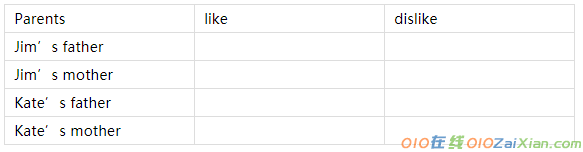
(The students work in groups.)
S2:Jim’s father likes… He doesn’t like… Jim’s mother likes…very much. She doesn’t like…And they both don’t like…
(Then ask more students to report.)
Step Four:Summary.
In this class, we’ve learnt the Simple Present Tense,including of the third person singular form as subject.
Homework.
Rewrite your conversation in the form of a passage.
Period Three
課前準備
教師:搜集關于食物的圖片,多媒體教學課件,制作表格(見教學步驟)。
學生:準備上一節課的家庭作業。
教學設計
Step One: Check the homework.
T:Now let’s cxchange your exercise books and help each other. Try to correct it.(Ask different students to report his/her conversation.)
Step Twp: Review the words.
T:You know we have learnt so much delicious food. Now Let’s play a game with the food. Let’s see who will say the names of the food as many as possible during a minute.
(The teacher will give the students a minute to prepare it.Then ask someone to say.)
S: Salad, apples, bananas, ice cream…
(Choose the three students who said the most and give some food as presents.)
Step Three: New words.
① Present the new words.
T:How many meals do you have every day?
Ss:Three.
T:What are they?(The students can answer them in Chinese.)
Ss:They are “早餐、中餐和晚餐 ”.
T:Oh, yes. In English “早餐”we can say “breakfast”.
(Show a picture of the breakfast)
Read after me, “breakfast”.
B-R-E-A-K-F-A-S-T,breakfast.
Ss: B-R-E-A-K-F-A-S-T,breakfast.
T:Do you have your breakfast every day?
S1:No, sometimes I get up late, I have no time to eat.
T:I think it’s not good for your health.
(Teach the other two words lunch, dinner in the same way.)
② Practice the words.
T:Which meal do you like best?(Point to a student.)
S:I like breakfast best.
T:Why?
S:Because I like drinking milk.
T:Who also likes breakfast in our class? Please put up your hands.
T:Oh, so many students.You can sit in this team.
(Ask all the students who like breakfast, lunch or dinner to come to the same team. They can talk easily.)
T:We have divided all the class into three groups. One group likes breakfast, the other two like lunch and dinner. But what do you like for your three meals?
(Show a picture of three dinners.)
T:I have three meal plates. What do you want to put on it?
Let’s talk about it. Try to find the food what your group like most and tell us the reason.
(When each group is talking about it, the teacher goes around among the students and helps them if they need. Then ask each group to report.)
S:In our group, we like breakfast best. We all like oranges, eggs, milk and an apple.Because they are good for our health, we choose them.
(When the student is saying, the teacher puts the food onto the plate for breakfast.)
(Do it for lunch and dinner in the same way.)
T:Look at 1a, and write the number in the box next to the correct food.
(Then the students finish off 1a.)
T:How many other food words can you add to the chart?
Try to write them down in the chart.
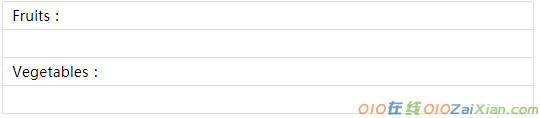
(The students write them down as soon as possible and then read them. See who will add most.)
Step Four: Practice the listening.
T: Look! There are so many foods. Maybe they are very delicious. Which food do you like? Do you like apples? (Show the picture.)
S1: …
T: How about chicken? Do you like it ?
S1: …
T: Can you guess what food I like?
S1: Do you like…?
T: No, I don’t.
S2: Do you like…?
S3: Do you like…?
T: Yes, you are right. I think you are very lucky. But I have two friends. They are Sandra and Tom. Do you know what food they like? Now, let’s listen and find out the food you hear.
(Play the recording 2a in Section B. The students find out each food mentioned in the conversation on the recording. Then check the answers.)
T: Now open your books and listen again. Fill in the chart.
(Play the recording the first time. Students listen to the conversation and write in the answers on their charts. Play the recording the second time and then the students can check their answers to be sure they are correct.)
T: Does Sandra like salad?
S: Yes, she does.
T: Work in pairs about the chart.
Step Five: Task.
Go on a picnic with a group of friends and make a list of food to buy.
① Divide the students into six groups.
② Talk about what the students in your group like and dislike and make a list.
③ The leader in each group reports to the class.
Step Six: Summary and homework.
Make a survey about “What do your parents like for three meals?” after class.
Period Four
課前準備
教師:搜集關于食物和人物圖片,制作表格(見教學步驟)。
學生:準備表格。
教學設計
Step One: New words.
T: Do you like sports?
S: Yes, I do. / Of course.
T: What sport do you like best?
S1:I like playing football/ baskball /table tennis …
S2:I like 跑步.
T: Oh, Look! What is he doing?
(Show the students a picture of Liu Xiang.)
Ss: He is 跑步.
T: Yes, he is running. Now, read after me, run.
S: Run.
T: R-U-N, run.
S: R-U-N, run.
T: Do you know him?
S: Yes, he is Liu Xiang.
T: You are very clever. He is Liu Xiang. He’s a runner.
R-U-N-N-E-R,runner.
S: R-U-N-N-E-R,runner.
T: Now he is very famous in China. Maybe everyone knows him. He is a sport star. S-T-A-R,star.
S: S-T-A-R,star.
T: Liu Xiang likes sports. He runs every day. He is healthy and he doesn’t like dessert. Do you know Healthy and dessert? Healthy means “健康的”. Can you guess the meaning of unhealthy?
Ss: “不健康的”.
T: Yes, you are clever. Read after me, healthy, unhealthy.
Ss: Healthy, unhealthy.
T: Look at these pictures. (Show these pictures of dessert.)
They are all dessert. In Chinese it means “甜食”.We often eat it after the important dishes.
T: Read after me, dessert, D-E-S-S-E-R-T, dessert.
Ss: D-E-S-S-E-R-T, dessert.
Step Two: Task.
T: Now look at the pictures of these foods. (Show some food pictures.) What kind of food do you think are healthy or unhealthy? Discuss in four people and fill in the chart. (Each group will have a chart)

(Ask some groups to report.)
S: … are healthy food, … are unhealthy food.
T: So we eat more healthy food and less unhealthy food. Healthy food is good for our health, but unhealthy food is bad for our health.
Step Three: Learn to write about what somebody likes for three meals.
① Read the passage.
T: Look at Liu Xiang ! Do you know why he is very healthy?
S1: Maybe he runs every day.
S2: He takes good care of his health.
S3: Maybe he eats very well.
T: Yes, he really eats very well. Every player just eats healthy food. Three is another running star. Her name is Sandra Dlark. Let’s see what she likes eating for three meals. Open your books and read 3a in Section B. First try to fill in the chart.
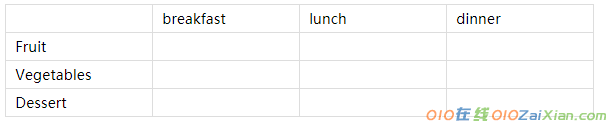
(The students read the passage and fill in the chart, then check the answers.)
S: Fruits…
T: Sandra Clark has a brother, Tom. He is very clever, but a little naughty. Look at 3b and find out what Tom likes for breakfast, lunch and dinner. Complete the following passage.
(The students do 3b and check the answers.)
S: Four lunch …
② Practice.
T: I like eggs and milk for breakfast. What do you like eating for breakfast?(Point to a student.)
S: I like apples and bread.
T: What about you? (Point to another student.)
S: I like hamburgers and bananas.( Ask two more students to answer his/her questions for lunch and dinner.)
T: Who can ask and answer like this?
Sa: What do you like to eat for lunch?
Sb: I like …
Sa: What do you like to eat for dinner?
Sb: I like …
(Then ask the students to work in pairs one by one.)
Step Four: Task.
① Write a passage about you like for three meals.
T: Can you introduce yourself for three meals according to what you talked about just now? Maybe many friends want to know you. (The students write about themselves as quickly as they can. When they are ready, ask them to introduce.)
② Make a survey about your classmates for three meals.
T: Do you have any friends? (Ask a student.)
S: Yes, I do./ Of course.
T: Do you know what they like eating for each meal?
S: No/ Sorry, I don’t know.
T: OK. Let’s ask our friends and try to know what they like. Then fill in the chart.

(Then ask some students to report to the class.)
Homework.
Write a passage about your best friend for three meals.
本文來源:http://www.nvnqwx.com/jiaoan/2700689.htm