春節(jié)是中華民族最隆重的傳統(tǒng)佳節(jié),同時(shí)也是中國(guó)人情感得以釋放、心理訴求得以滿足的重要載體,是中華民族一年一度的狂歡節(jié)和永遠(yuǎn)的精神支柱。春節(jié)與清明節(jié)、端午節(jié)、中秋節(jié)并稱為中國(guó)四大傳統(tǒng)節(jié)日。下面就是小編整理的英語(yǔ)小報(bào)春節(jié)內(nèi)容,一起來(lái)看一下吧。
春節(jié)英語(yǔ)小報(bào)內(nèi)容1
Chinese New Year is coming soon. I am very happy! I can put on my new clothes. We can get a lot of lucky money. We can eat a big dinner. We can do many interesting things. I expect Chinese New Year coming.
春節(jié)快到了。我很高興!我可以穿上我的新衣服。我們可以得到很多壓歲錢。我們可以吃一頓豐盛的晚餐。我們可以做很多有趣的事情。我期待農(nóng)歷新年到來(lái)。
春節(jié)英語(yǔ)小報(bào)內(nèi)容2
Spring Festival is the most important festival in China. It’s to celebrate the lunar calendar’s New Year. In the evening before the Spring Festival, families get together and have a big meal. Children like the festival very much, because they can have delicious food, wear new clothes, and also get some lucky money from their parents. Parents want this money will bring good lucky to children. The Spring Festival lasts about 15 days long. People enjoy the Spring Festival, during this time they can have a good rest.
春節(jié)是中國(guó)最重要的節(jié)日。這是為了慶祝農(nóng)歷新年。在春節(jié)前的晚上,家人聚在一起吃一頓大餐。孩子們非常喜歡這個(gè)節(jié)日,因?yàn)樗麄兛梢猿悦牢兜氖澄铮┬乱路€可以從父母那里得到一些壓歲錢。父母希望這筆錢能給孩子帶來(lái)好運(yùn)氣。春節(jié)大約持續(xù)15天。人們享受春節(jié),在這段時(shí)間里他們可以好好休息。
春節(jié)英語(yǔ)小報(bào)內(nèi)容3
Chinese New Year is a lovely festival. So I bought some beautiful flowers. Before Chinese New Year, my family went to the shopping mall and bought a lot of things. There will be a big dinner for every family. My family eats the big dinner together. I was very happy in Chinese New Year.
春節(jié)是一個(gè)可愛的節(jié)日。所以我買了一些漂亮的花。春節(jié)前,我的家人去購(gòu)物中心買了很多東西。每個(gè)家庭都會(huì)有一頓豐盛的晚餐。我們?nèi)乙黄鸪源蟛汀N以诖汗?jié)過(guò)得很開心。
春節(jié)英語(yǔ)小報(bào)內(nèi)容4
The first day of the first lunar month is the Spring Festival, also known as the lunar calendar year, commonly known as "the New Year". This is one of the most solemn and lively traditional festivals in our country.
Spring Festival is the most important festival of the han nationality. However, our country is a multi-ethnic country, besides han nationality, and full, Mongolia, yao, zhuang, white, mountains, hezhen, hani, daur, dong, li and so on more than a dozen ethnic minorities have the custom of Spring Festival.
The Spring Festival has a long history. It originated from the worship of god at the end of the shang dynasty. There are also many legends about the year. The ancient Chinese New Year is called "yuan day", "New Year's day" and "New Year". After the revolution of 1911, the first lunar month was officially called Spring Festival.
The long history of the years makes the content of the vulgar activities colorful. Among them, those who worship god day offering superstition, has gradually been eliminated, and the rich content of the life interest, like to stick couplets on the Spring Festival, post pictures, stick to "f" word, cut grilles, steamed rice cakes, dumplings, burning fireworks, New Year's eve vigil, such as New Year customs are still very popular.
The earliest spring couplet in China was written by meng chang on the peach board in the five dynasties period: "New Year na yuqing, jiarun chang changchun".
Writing the Spring Festival in red paper begins in the Ming dynasty. The painting originated from the tang dynasty god, which, like firecrackers, was used to exorcise evil spirits in ancient times, but now it has become a custom for increasing the festive atmosphere. The word "fu" was written before the song dynasty. People wrote the word "fu" on red square paper and deliberately put it on the door, window and furniture, and took it as the meaning of "blessing to fall".
New Year's eve is the most important custom of the year, which was recorded in the wei and jin dynasties. On New Year's eve, to spend the evening with the family, to celebrate the year, to gather and drink, to share the happiness of the family, this is the annual custom that the Chinese people still pay great attention to. After the first rooster crowing, the New Year begins, both men and women of old and young are dressed for the festival, first to celebrate the elderly in the family, and then to the friends, to congratulate each other. From the first to the fifteenth, people have been immersed in the festive atmosphere of happiness, peace and civilization.
農(nóng)歷的第一天是春節(jié),也被稱為農(nóng)歷年,俗稱“新年”。這是我國(guó)最隆重、最熱鬧的傳統(tǒng)節(jié)日之一。
春節(jié)是漢族最重要的節(jié)日。然而,我國(guó)是一個(gè)多民族的'國(guó)家,除漢族外,滿、蒙古,瑤、壯、白、高山、赫哲、哈尼族、達(dá)斡爾、侗、黎等十幾個(gè)少數(shù)民族春節(jié)習(xí)俗。
春節(jié)有著悠久的歷史。它起源于商代末期的上帝崇拜。還有很多關(guān)于這一年的傳說(shuō)。中國(guó)古代的新年被稱為“元日”、“元旦”和“新年”。1911革命后,第一個(gè)農(nóng)歷月正式被稱為春節(jié)。
悠久的歷史使庸俗活動(dòng)的內(nèi)容豐富多彩。其中,敬拜神天祭的迷信,已經(jīng)逐漸被淘汰,和生活情趣的豐富內(nèi)容,喜歡在春節(jié)時(shí),貼春聯(lián),貼上照片,堅(jiān)持“F”字,剪窗花,米飯蛋糕,吃餃子,放煙花,除夕守夜,如新年的習(xí)俗仍然很受歡迎。
在中國(guó)最早的春聯(lián)是寫的孟昶在桃板在五代時(shí)期:“新年納余慶,佳潤(rùn)昌長(zhǎng)春”。
在紅色紙上寫春節(jié)開始于明朝。繪畫起源于唐代的神,像放鞭炮一樣,是用來(lái)辟邪在古代,但現(xiàn)在它已成為增加節(jié)日氣氛的習(xí)俗。賦是宋代以前的文字。人們把“福”字寫在紅場(chǎng)紙上,故意把它放在門、窗、家具上,把它當(dāng)作“降福”的意思。
除夕是一年中最重要的風(fēng)俗,記載在魏晉時(shí)期。在除夕夜,與家人共度夜晚,慶祝一年,聚在一起喝酒,分享家庭的幸福,這是中國(guó)人仍然十分重視的年度習(xí)俗。第一只公雞啼叫之后,新的一年開始,男性和老年和年輕女性穿著的節(jié),第一次慶祝老年人在家庭中,然后到朋友,相互祝賀。從第一到第十五,人們沉浸在歡樂、和平、文明的節(jié)日氣氛中。
英語(yǔ)小報(bào)欣賞:
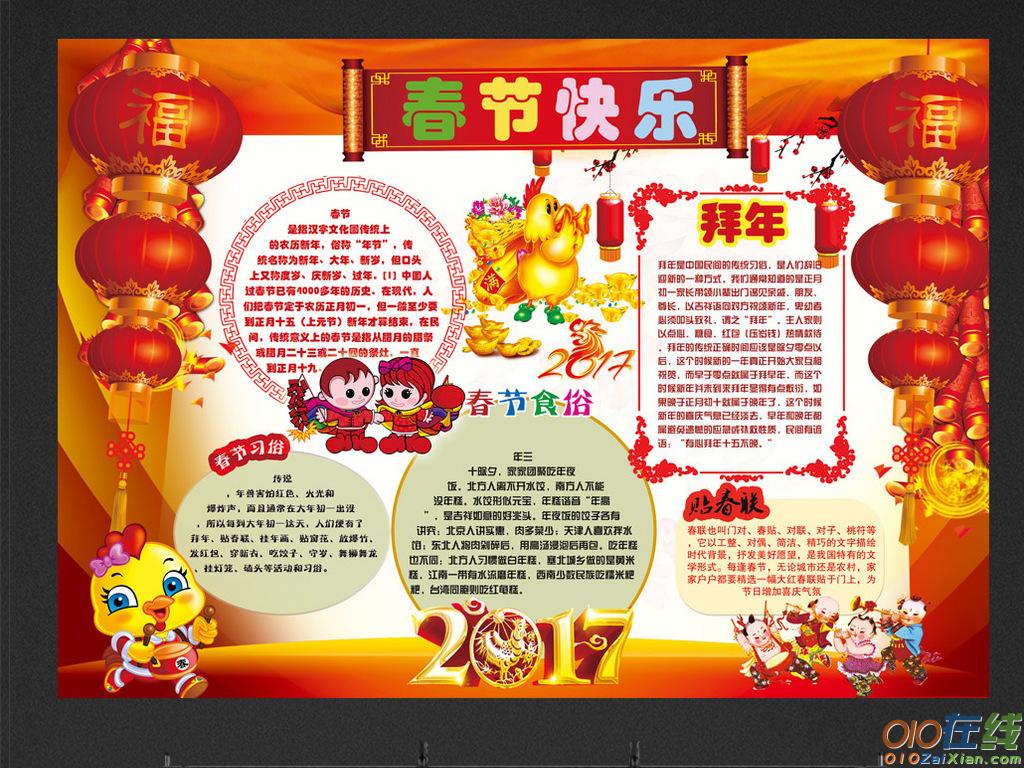
英語(yǔ)小報(bào)春節(jié)內(nèi)容1
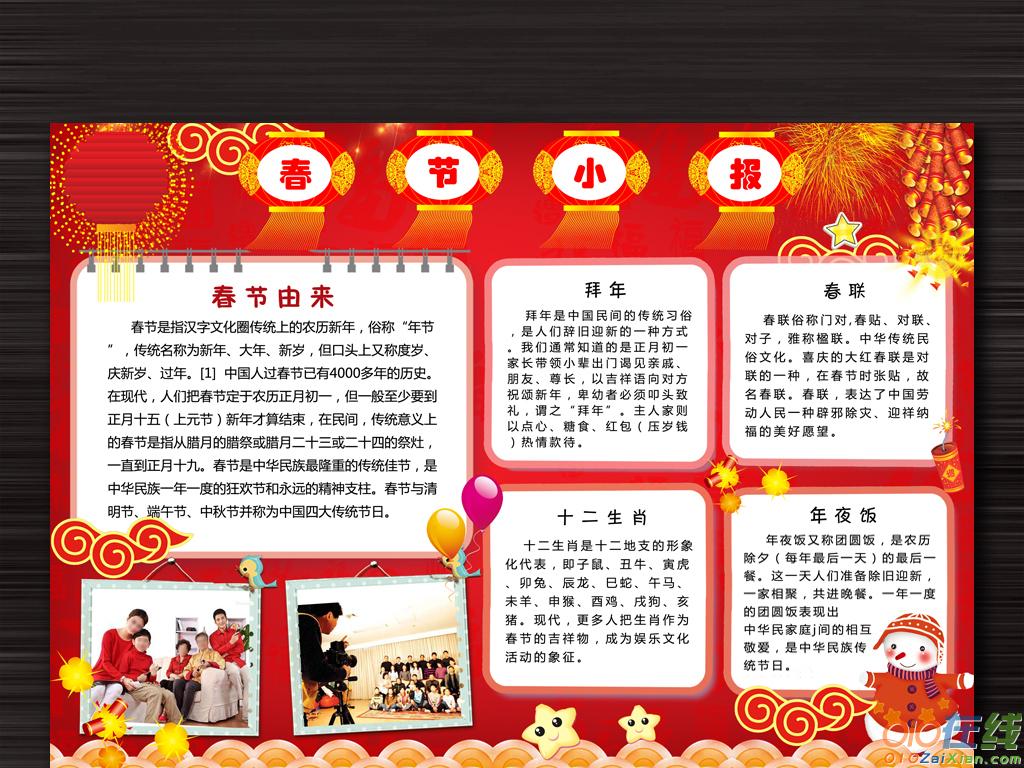
英語(yǔ)小報(bào)春節(jié)內(nèi)容2
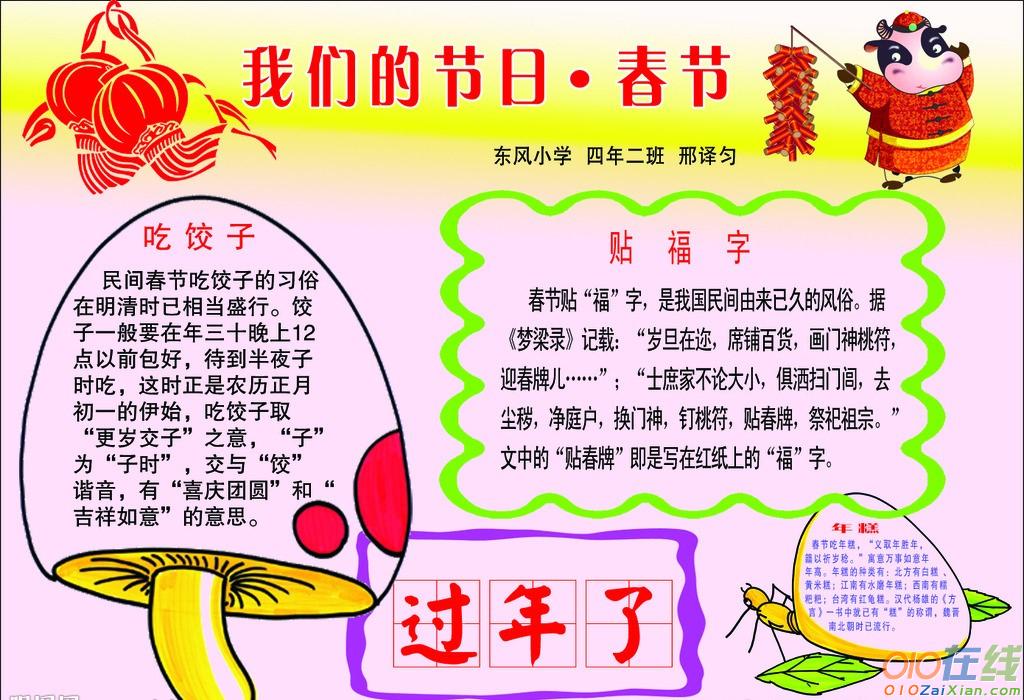
英語(yǔ)小報(bào)春節(jié)內(nèi)容3
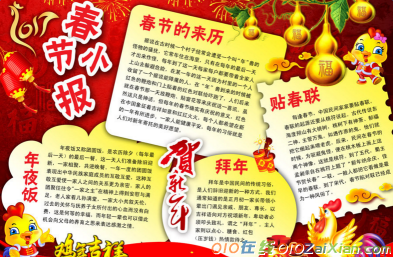
英語(yǔ)小報(bào)春節(jié)內(nèi)容4
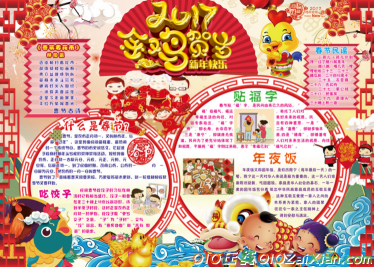
英語(yǔ)小報(bào)春節(jié)內(nèi)容5
【英語(yǔ)小報(bào)春節(jié)內(nèi)容】相關(guān)文章:
8.春節(jié)小報(bào)內(nèi)容簡(jiǎn)短
本文來(lái)源:http://www.nvnqwx.com/wenxue/banbao/1853366.htm